
Storing Dried Herbs for Tea & What Actually Keeps Them Fresh
By: Dawn Writes Co.
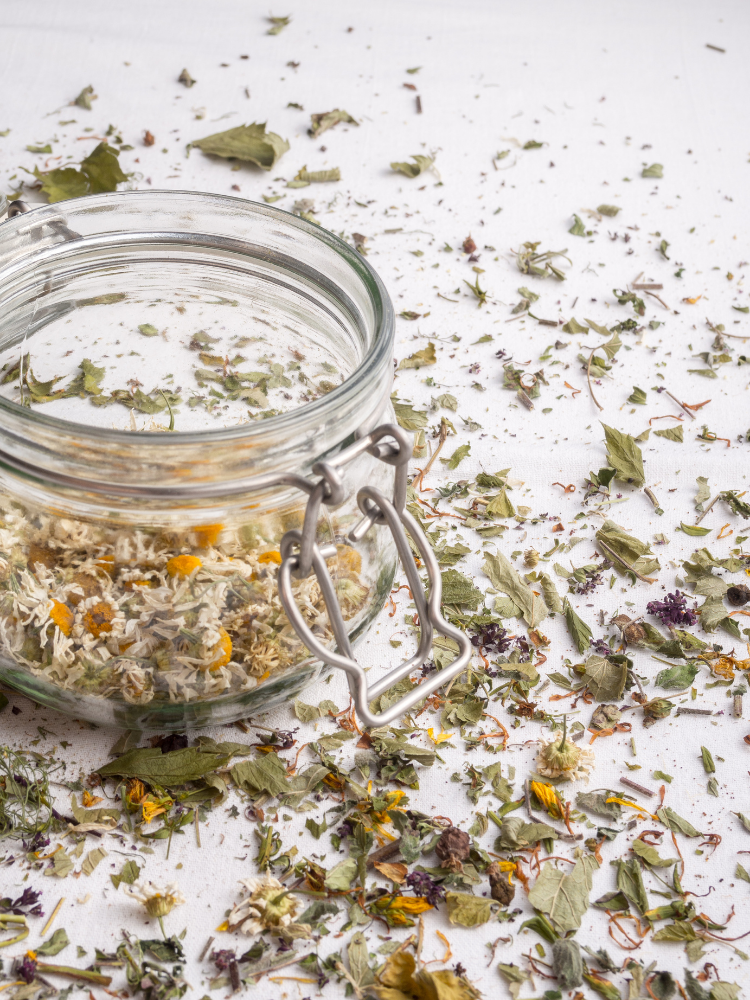
You've harvested and dried your herbs. What happens next determines whether they hold onto their flavor for months or turn into tasteless dust in a matter of weeks.
Storage isn't complicated, but the details matter. Here's how to keep dried herbs at their best.
What Ruins Dried Herbs
Light breaks down essential oils and fades color fast. Herbs in clear containers, especially near a sunny windowsill, lose potency quickly. Air causes the same kind of damage through oxidation; the more air that gets into a container, the faster everything inside fades. Heat speeds up how quickly those oils evaporate, which is why many "convenient" storage spots turn out to be bad once you factor in a nearby stove or a sunny counter.
Moisture is the least forgiving of the bunch. It doesn't take actual water; just damp air finding its way in is enough to start mold.
Best Storage Containers
Dark amber or cobalt glass with an airtight lid is my top pick. It blocks light and seals in moisture well. Clear glass works too, as long as it's tucked into a cabinet, pantry shelf, or drawer where light can't reach it. The only real downside is that glass breaks, but for something reusable and easy to clean, it's a small tradeoff.
Metal tins come in second. They block light completely and hold up well over time, though you can't see what's inside without opening the lid, and very acidic herbs can occasionally react with metal over long stretches.
Food-grade plastic works for the short term—three to six months, tops. It's cheap and won't shatter, but it's rarely as airtight as glass or metal, and clear plastic still lets light through.
Paper bags only make sense for very short-term storage, days to weeks. They're breathable, which is actually useful at the tail end of drying, but they're not airtight, and herbs stored in them fade fast.
Skip cardboard (absorbs moisture), Ziploc-type bags (too much air gets in), and anything clear that sits in direct sun.
Where To Keep Them
Somewhere cool, dark, and dry. Think a closed cabinet, not a spot near the stove, oven, or dishwasher. Windowsills trip people up more than you'd think, even with dark glass, since temperatures near a window swing more than expected. Open shelving in direct sun has the same problem, and so does any humid spot, since heat tends to rise more than people account for.
Handling
Keep herbs whole when you can, which means leaves intact and flowers whole. Crushing or grinding increases surface area, and that's when essential oils start evaporating fast. Crush right before use for the best flavor. If you need to pre-crush for convenience, store it airtight and use it within three to six months.
Fill containers nearly to the top. Less headspace means less oxidation. Just don't pack the herbs down, or they'll crumble.
Label everything. At a minimum, include the herb name and date. That way you're always working through the oldest stock first instead of guessing, which matters once a few dried herbs start looking alike.
Herbal Shelf Life
So how long do dried herbs actually last? It depends a lot on the herb itself. Leafy ones like mint, lemon balm, and basil are on the shorter end, meaning figure on about a year before they start losing their edge. Woody herbs hold up better; rosemary, thyme, and oregano can go a year, sometimes two, without much drop-off. Flowers are the most delicate of the bunch, such as chamomile, lavender, calendula, and you're usually looking at six months to a year before they fade. Roots are the exception. Ginger, in particular, can sit in storage for two to three years and still be worth using.
None of this is a hard cutoff, though. Herbs don't spoil the way food does. They just slowly lose potency. Something a few months past its "prime" window can still smell great and work fine in the kitchen. Trust your nose more than the calendar.
Signs Something's Off
Mold, white spots, or fuzzy growth means moisture got in. Toss the whole container; don't try to salvage part of it. Faded or gray color usually means the flavor's gone even if the herb's still technically safe. Crush a bit between your fingers. If there is no fragrance, the oils have evaporated; it's still usable, just bland. A musty smell is the one red flag you can't ignore. That's moisture or mold.
Avoiding The Usual Problems
Moisture is the biggest problem that most people run into. You can avoid this by using containers you have tested for a seal and making sure the herbs are fully dry before long-term storage. A food-safe silica packet helps, especially in a humid climate.
Pests — pantry moths, weevils — are the next most common issue. Airtight glass or metal keeps them out far better than plastic bags. If you do find an infestation, freeze the herbs for 48 hours to kill anything living in there, then move everything to a clean container.
Flavor loss beyond that usually comes down to light, heat, too much air, or herbs crushed before storage; all things the steps above already cover.
A Couple of Extras
If you harvest a lot at once, run a two-container system: one large airtight jar for the bulk, kept in your best spot, and a smaller jar for daily use that you refill. That keeps your main stock from getting opened and exposed every time you need a pinch.
Freezing herbs will extend their shelf life; however, most herbs don't need it. If you do freeze, use truly airtight containers or vacuum-sealed bags, make sure the herbs are bone dry first, and label clearly. Frozen herbs can last one to two years, but regular pantry storage works for most people.
I've tried organizing my own collection alphabetically, by how often I use something, and lately just by what I tend to blend. Whatever matches your habits and space is the right system.
Airtight, cool, dark, dry, labeled. Get that much right and the herbs you worked to grow and dry will actually taste like something for months.